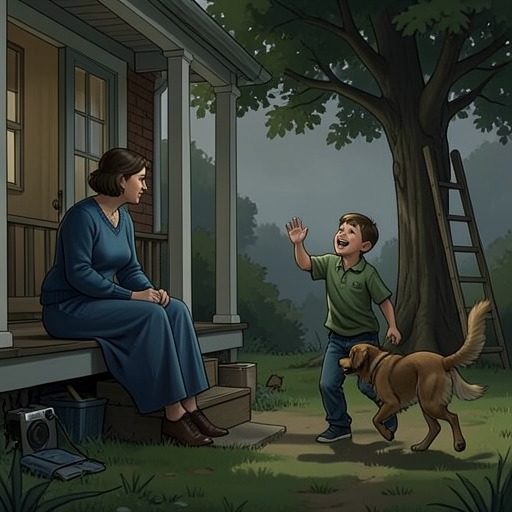
Timbre meets Crew for the first time
Hayden's TimbreTimbre meets Crew for the first time under circumstances that make the encounter both practical and emotionally consequential. Hayden has a show that night after rehearsing with his band for several weeks, but Crew is sick, confined to bed, and cannot be left alone. Because Peri and Ryan have gone on a trip to protect their own children from exposure to the illness, Hayden asks Timbre to come to his home and sit with Crew. Her willingness to arrange an Uber and arrive before Hayden leaves turns a favor into the first face-to-face meeting between Timbre and the boy who occupies the center of his father’s life.
Circumstances and Hesitation
Timbre’s decision follows an explicit acknowledgment of the help Hayden has already given her. She reminds him that he has done nothing but help her since the incident in which he gave her a bath in street water, and her sincere tone establishes that she is not accepting his request casually. Hayden’s need is specific: his professional commitment matters, but Crew’s illness makes parental supervision nonnegotiable. He therefore asks Timbre to remain with Crew rather than abandon the show or leave his son unattended.
The arrangement also exposes the limits Timbre places around her connection with Hayden. She agrees to come, but first asks whether Peri can give her a ride; when she learns that Peri and Ryan have left town, she offers to get an Uber herself. Her practical response allows her to help without presenting herself as dependent on Hayden. At the same time, she understands that meeting Crew is not an ordinary favor. Hayden says they could spend a little time with him together if she came immediately and admits that this is not how he wanted the two of them to meet. Timbre responds by releasing him from the obligation to explain their relationship, suggesting that he identify her as a friend, someone he met earlier who now works for 13 Recordings, or simply a co-worker.
The First Meeting
The encounter begins with Timbre waiting in the house while Crew rests. She dozes in front of the television and wakes to find someone watching her. The first image she receives of him is affectionate and immediate: Crew is an adorable child who resembles Hayden so closely that he appears to be his father made over. Her observation also extends into a projection of his future, imagining that he will become a large and attractive young man.
Crew introduces himself as Crew and extends a hand larger than Timbre’s. The gesture makes his physical presence vivid without reducing him to his illness. Although he is still recovering, he is alert enough to approach her, speak with her, and take control of the television remote. Timbre stands as well and meets his eyes before introducing herself as Timbre. The exchange is brief, but its mutuality matters: she does not merely observe Hayden’s son from a distance; she enters into a direct social relationship with him.
Crew Reads the Situation
Crew immediately asks Timbre whether she is dating his dad. His directness punctures the cover story before it has time to settle. Timbre answers that they work together, following the safer explanation she had proposed before arriving. Crew notes that Hayden has given the same answer but noticed a funny look on his face while doing so. In this way, the child becomes the scene’s most perceptive interpreter of the adults’ guarded language.
The question changes the value of the meeting. Timbre had approached the visit as repayment for Hayden’s kindness and as temporary care for a sick child. Crew’s question makes the hidden romantic connection present in the room, even though neither adult formally names it. His perception also creates a small conflict between what Hayden and Timbre say and what their expressions reveal. The relationship is still being denied in words, but Crew can already sense that the official explanation does not contain the whole truth.
Relationship and Narrative Function
The meeting links Hayden’s parental priority with Timbre’s emerging place in his life. Hayden cannot simply invite her into a private romance detached from his responsibilities; any serious connection must encounter Crew, whose health, safety, and understanding govern Hayden’s choices. Timbre’s willingness to come when Crew is ill shows care expressed through action rather than declaration, while her insistence that Hayden need not explain the relationship protects both his privacy and the child’s immediate situation.
At the same time, Timbre’s language reveals her resistance to intimacy. She treats the visit as something she can do to repay Hayden, not as evidence that she belongs in his family sphere. Her proposed labels—friend, acquaintance from an earlier time, or co-worker—preserve distance and postpone recognition of the bond between them. Crew’s question exposes that distance as unstable. The first meeting therefore functions as a threshold: Timbre enters Hayden’s domestic world through illness and necessity, but Crew’s scrutiny makes clear that her presence may eventually have consequences far beyond one evening of babysitting.
Significance
Timbre meets Crew for the first time in a scene built from competing obligations: Hayden’s band performance, Crew’s recovery, Peri and Ryan’s decision to keep their children away from illness, and Timbre’s wish to help without claiming an intimate role. The meeting does not resolve the status of Hayden and Timbre’s relationship, but it makes that unresolved status visible to the person whose acceptance will matter most within Hayden’s family life.
Crew’s introduction also establishes him as more than the reason Hayden needs assistance. He is an active participant who approaches Timbre, identifies himself, asks for a handshake, tests the explanation she gives, and notices Hayden’s expression. The first meeting consequently shifts the story from private adult attraction toward a possible family relationship. Timbre arrives as a helpful co-worker by description; she leaves the scene, at least in Crew’s eyes, as someone whose connection to his father may be something more.